HOME
" Introduction to Operating System "
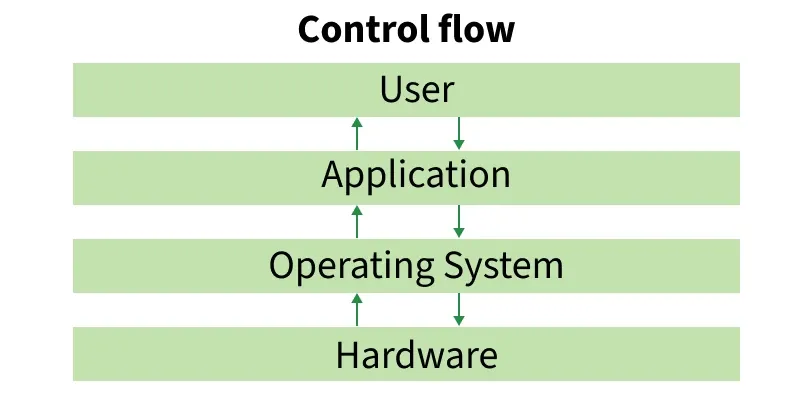
An Operating system acts as an intermediary between the computer hardware and the user. In short, it is an interface between computer hardware and the user.
->The purpose of an operating system is to provide an environment in which a user can execute programs conveniently and efficiently.
-> The operating system (OS) is a program that runs at all times on a computer. All other programs, including application programs, run on top of the operating system.
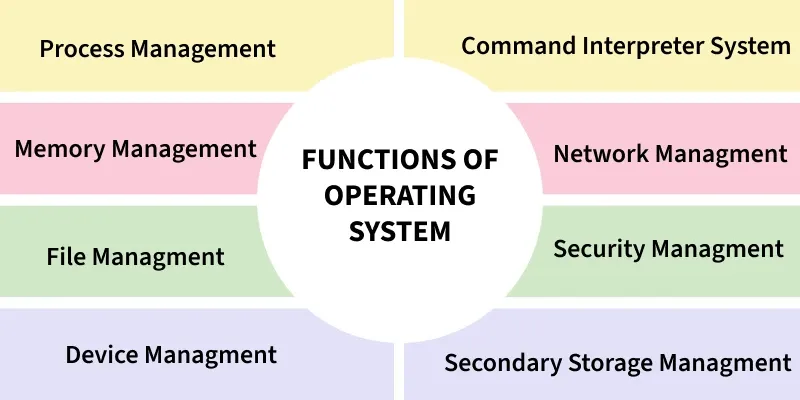
-> It assigns resources such as memory, processors, and input/output devices to processes that need them. The assignment of resources has to be fair and secure.
Operating System and User Interaction:
Every general-purpose computer consists of hardware, an operating system, system programs and application programs.- The hardware includes CPU, ALU, memory, I/O devices, peripheral devices and storage devices.
- The system programs include compilers, loaders, editors and the OS itself.
- The application programs are user-level software that perform specific tasks.

An operating system is always running in the background to manage and coordinate the use of hardware resources among system and application programs for multiple users. The OS itself is not only a user interface. Instead, it provides an interface for user interaction, typically through:
- Command-Line Interface (CLI), (e.g., Bash, PowerShell)
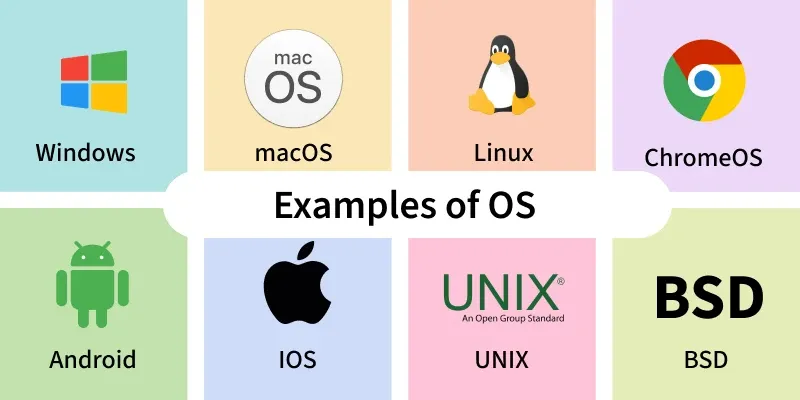
- Graphical User Interface (GUI), (e.g., Windows desktop, macOS Finder)
# DISK SCHEDULING:
-> It is an operating system process that manages the order of I/O requests for a hard disk to improve efficiency and speed.
# DISK SCHEDULING ALGORITHMS IN OS:
"Disk Scheduling Algorithms" in an operating system can be referred to as a manager of a shopping store that manages all the incoming and outgoing requests for clothes of that store.It keeps a record of what is available in-store, what we need further, and manages the timetable of transaction of goods.
The 'Disk Structure in OS' is made in such a way that there are many layers of storage blocks on the disk. When we need to access these data from disk, we initialize a 'request' to the system to give us the required data. These requests are done on a large scale. So, there is a large number of input and output requests coming to the disk.
The operating system manages the timetable of all these requests in a proper algorithm. This is called a "Disk Scheduling Algorithm in OS". This algorithm helps OS to maintain an efficient manner in which input-output requests can be managed to execute a process. It manages a proper order to deal with sequential requests to the disk and provide the required data.
Since multiple requests are approaching the disk, this algorithm also manages the upcoming requests of the future and does a lining up of requests.
Comments
Post a Comment